Build engineering
Making Regional Boundaries Part of the Build
Hiding a navigation link does not remove a server route or its dependencies. I checked the built artifact so each regional deployment contained the surfaces it was meant to run.
Senior AI Engineer · M.S. Computer Science, Tsinghua University · See the products I built
In this article · 5 sections
The engineering decisions
- Enforce route and dependency boundaries in the built artifact, not just in the UI.
- Derive public assets from reachable references and verify their bytes.
- Smoke-test the final runtime without build-time database or snapshot configuration.
A hidden link is not an excluded capability
The codebase contained marketing, commerce, venue operations and native API surfaces. A region that did not run the venue platform should not receive those routes simply because they shared the repository. Removing a menu entry would not prevent a direct request or remove the traced dependency graph.
The China build excluded the overseas venue and workflow surfaces. Overseas builds excluded China-specific operational and snapshot surfaces. I treated route membership as an artifact property to verify, rather than a convention that every component author had to remember.
An offline build also needs an offline content runtime
The signed public-content snapshot used a pure adapter that did not load the CMS framework configuration or create a database adapter. The verified bytes were materialized into the release and read by dynamic public pages at runtime. This was more than supplying a temporary file during compilation.
The final application was started with build-time snapshot variables and database addresses cleared for the public-content smoke checks. That exposed pages which accidentally reached back into the CMS path after a successful build. Business operations with their own database requirements remained a separate boundary.
Inspect what the server will actually carry
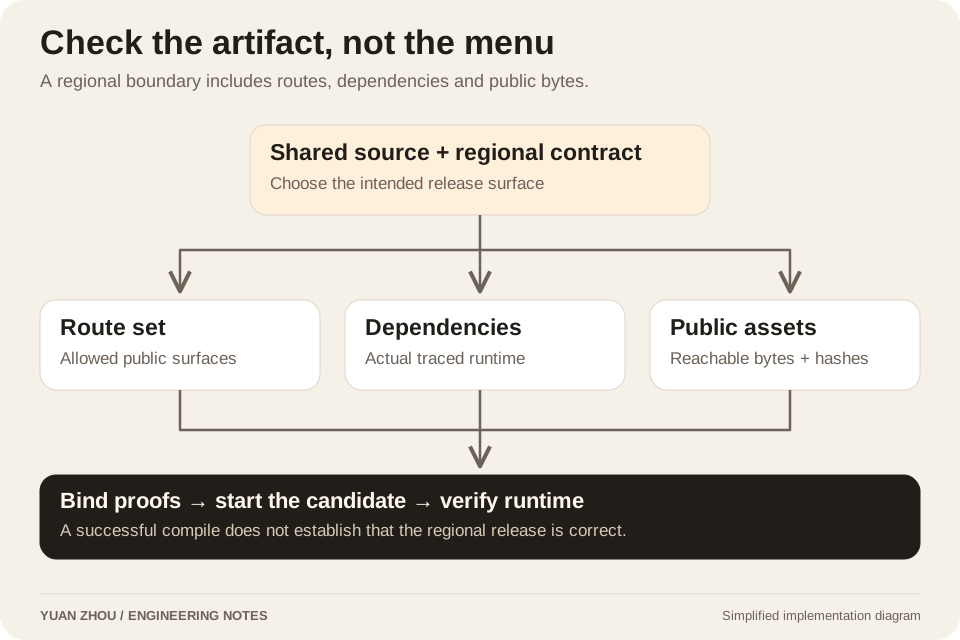
The build scanned server output, route manifests, runtime aliases and traced dependency files for excluded workflow code. The packaging stage verified the proof before removing platform-specific tracing metadata. The server then checked candidate hashes and boundaries again.
Native packages also had to match the target runtime. A macOS build machine or an overseas function’s architecture was not a reason to copy its native bindings into the China Linux runtime. The contract normalized the required architecture and bound the resulting trace evidence to the candidate.
Measure reachable output instead of copying everything
The public asset manifest came from references in the approved content and final output. Packaging copied that reachable set and checked paths, sizes and digests, rather than copying the entire public directory. Missing, extra or substituted files could then be detected during candidate verification.
The route budget checks started the freshly built application and measured the initial HTML’s JavaScript and CSS references. Ordinary public pages were not allowed to pull in the 3D renderer on their initial path. Server budgets measured the real traced files too. These were release limits, not claims of a measured conversion improvement or a universal page-speed score.
Bind the checks to the version being released
Route, dependency, asset and snapshot evidence described a particular built candidate. Reusing a proof from a different revision would defeat the purpose of verifying the artifact. The server’s job was to validate, start and switch the prebuilt output while keeping a compatible recovery path.
This article describes the recorded production build contract. The separate signed-content article explains content authority, and the independent release lab demonstrates a narrower byte-verification and policy model. Neither a passing lab nor a signed manifest alone establishes every regional customer workflow.
Project context and evidence
Written from my August to September 2026 regional build and prebuilt-release contracts. Public links below support the product and attribution context. Internal project records are summarized, with customer records, credentials, and employer source code omitted.
- GolfJoy China storefront ↗
Public regional product outcome.
- Independent release verification lab ↗
Standalone reference code, not employer implementation.
- GolfJoy engineering case study ↗
Public product interfaces and attribution for the delivered projects.