I started in native mobile development, then worked on AH-64 avionics and electrical systems in the U.S. Army. At Tsinghua University, I studied failure modes in Android system services. Product engineering brought those interests together: useful interfaces supported by systems that can be understood and tested.
My work at Multiverse Labs covered full-stack products and applied AI. I was the project lead and sole developer for the GolfJoy software described here, using AI tools while retaining responsibility for implementation, integrations, testing, and delivery. The case study presents the product interfaces, engineering decisions, and current public status.
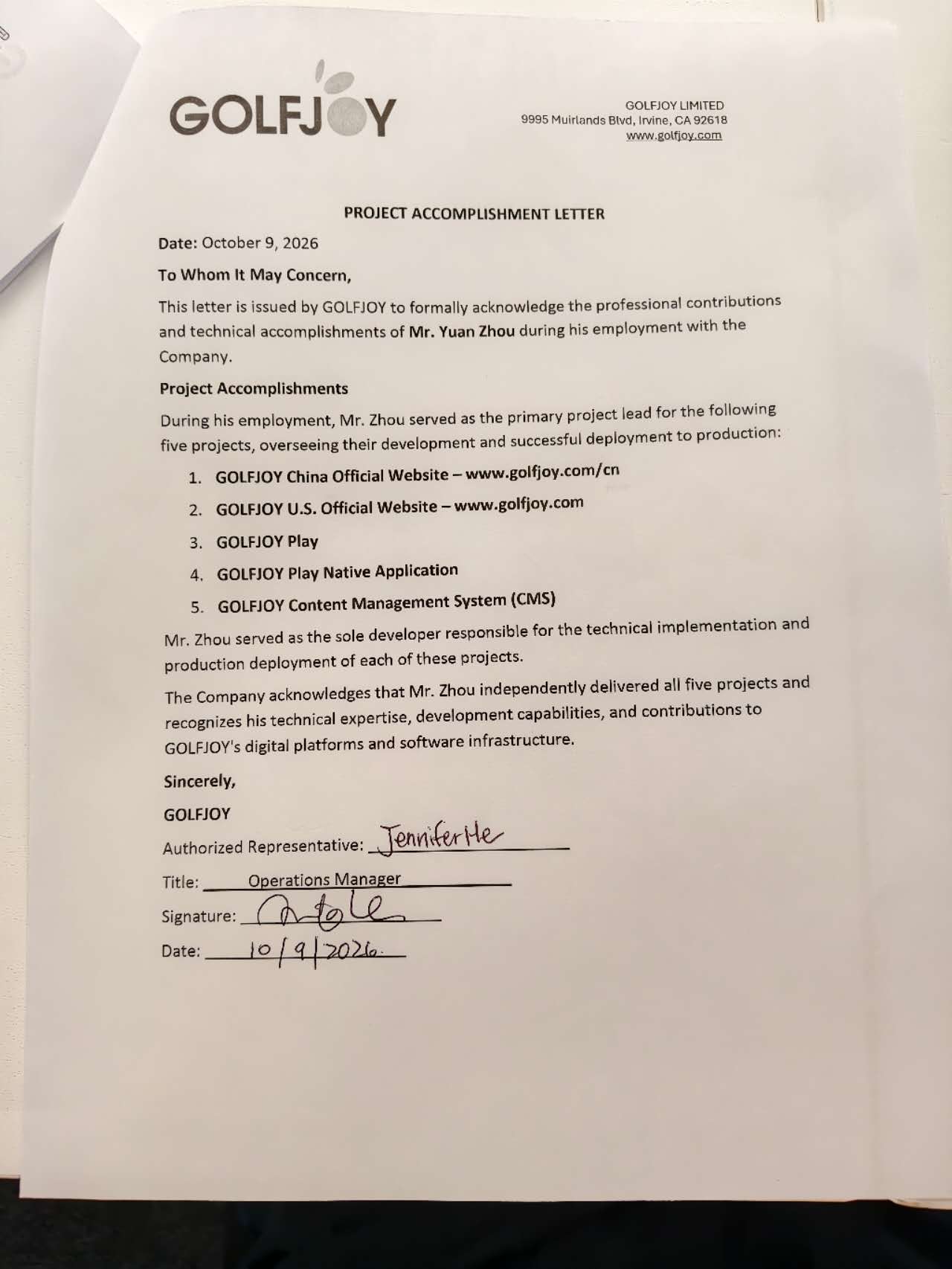
The company identifies Yuan Zhou as the primary project lead and sole developer responsible for technical implementation and production deployment of the five projects named in this letter.
Five projects documented in the letter
•GolfJoy China official website
•GolfJoy U.S. official website
•GolfJoy Play
•GolfJoy Play native application
•GolfJoy Content Management System (CMS)
The letter records delivery responsibility as of its date. The case study separately identifies the public preview and deployed product links available for review.
Project Accomplishment Letter. Select the image to enlarge; the summary and named projects are also available as text.
How I work
AI helps me build. The judgment stays with me.
01
Define the system before dividing the work.
I start with the user journey, the source of truth for each piece of data, and the boundaries between components. A booking, price, or sensor reading needs a clear meaning before it becomes an interface.
02
Use AI with reviewable boundaries.
I use AI tools to explore approaches, implement changes, and review code. I break the work into explicit tasks, review the integration points, and remain responsible for architecture, testing, and delivery.
03
Test what happens when a dependency fails.
The useful questions are often about the failure path: stale content, invalid signatures, duplicate requests, or lost device connections. My public release-gate lab makes one part of that approach inspectable.
Understand the failure. Then make it reproducible.
JNI Global References Are Still Vulnerable: Attacks and Defenses
Co-first author · IEEE TDSC 19(1), pp. 607–619 (2022). Author manuscript posted May 1, 2024.
Developed JGREAnalyzer for cross-language analysis and validation of Android resource-exhaustion flaws. The paper reports 21 vulnerable interfaces across 12 of 148 Android 10 system services; nine were exploitable without permissions.