Payment reliability
A Checkout Return Is Not Proof of Payment
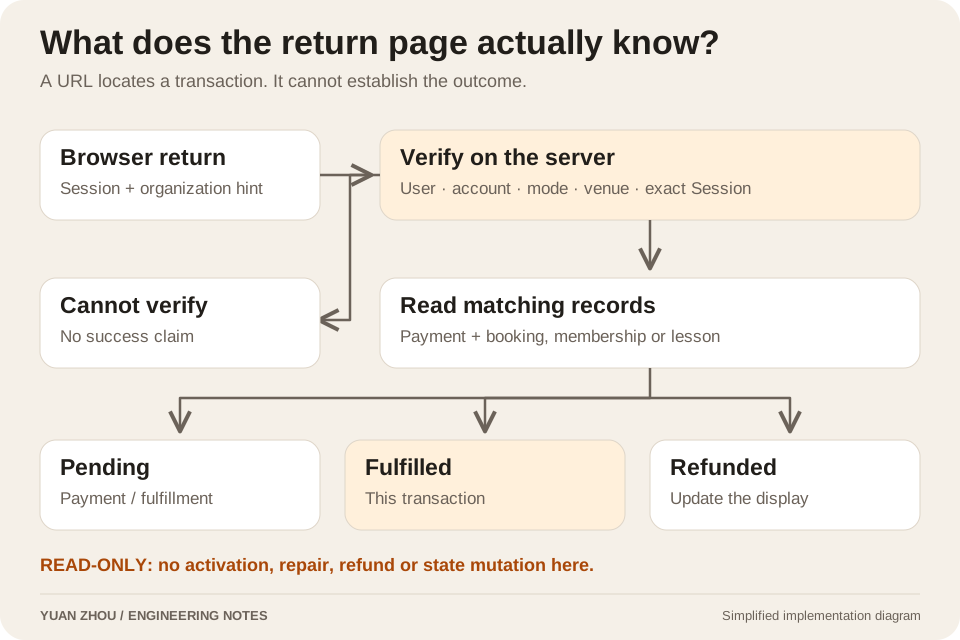
A success URL can arrive before fulfillment, after a refund, or without a valid transaction. I rebuilt the return page around verified transaction identity and explicit states.
Senior AI Engineer · M.S. Computer Science, Tsinghua University · See the products I built
In this article · 6 sections
The engineering decisions
- Treat the return URL as a transaction locator, never as authorization or proof.
- Verify the current user, account, environment, venue and exact Checkout Session on the server.
- Keep return-page reads separate from fulfillment and show unresolved or refunded states honestly.
A URL flag cannot establish a purchase
The failure mode was easy to miss in a happy-path demo: a visitor returns with a flag such as paid or membership, and the page announces success. The flag alone does not prove that this user paid for this booking. It can be stale, incomplete or unrelated to the business record currently visible on the page.
I changed the return path to carry the Checkout Session identifier and an organization locator. The locator only identifies which existing payment account to query. It is not an authorization credential. The server must establish the relationship among the signed-in user, transaction and requested business outcome.
Resolve the exact transaction in its account scope
The resolver reads the Session from the relevant Stripe account and checks the user, organization, payment mode, stable venue and Connected Account. It then reads the payment and associated business record for that transaction. An old booking belonging to the same customer cannot be used to confirm a different payment.
Missing evidence and another user’s Session both lead to an unverifiable result. That response must not leak the other customer’s amount, venue or reservation details. The login redirect preserves transaction locators so that signing in does not destroy the context needed for verification.
| Evidence | Useful for | Insufficient for |
|---|---|---|
| Return URL flag | Choosing a return view | Payment or membership activation |
| Session ID + organization hint | Locating the transaction | Permission to view it |
| Verified provider Session | Transaction identity and account scope | Completed business fulfillment |
| Matching payment + business record | The result for this transaction | An unrelated order or later billing cycle |
Pin a subscription result to its first invoice
Subscription checkout needed a different path from one-time payments. A Session may not expose a useful payment intent for the initial subscription result. Following the subscription’s latest invoice is also unstable: by the time the customer revisits the link, that value may refer to a later billing cycle.
I used the invoice associated with the original Session and looked up its period ledger by account, environment and invoice identity. For historical Sessions without that field, the fallback was narrow: the already-linked local contract had to have exactly one initial subscription invoice record. Duplicate candidates or a recurring invoice were not grounds to guess.
A result page observes, it does not fulfill
The return resolver does not issue a refund, activate a membership, repair a booking or mutate payment state. Fulfillment remains in its designated processing path. Refreshing a receipt should not become a second way to perform a financial operation.
The interface distinguishes confirmed fulfillment, pending confirmation, refund in progress, refunded, manual review and unverifiable results. It can revise an earlier success banner if a later read finds a refund. A cancellation return is similarly limited: it records navigation back to the site, not proof that no charge occurred.
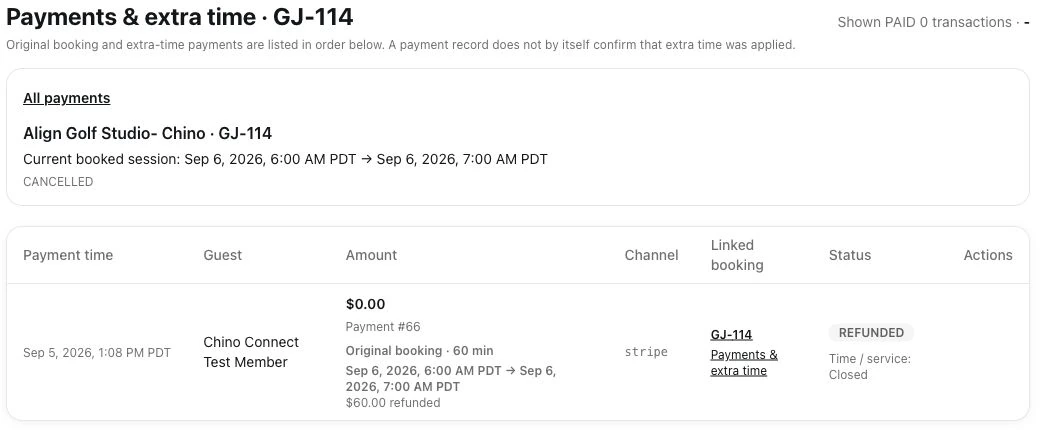
Use existing records without manufacturing a payment
The recorded regression suite covered 39 cases, including cross-user access, test/live separation, an old booking mistaken for a new transaction, initial versus recurring invoices, pending fulfillment and refund precedence. It also checked frozen subscription pricing and partial-refund presentation.
The September 14 authenticated test used existing records. It verified missing Session evidence, a refunded transaction and another user’s Session. The available accounts had no unrefunded successful payment or initial subscription invoice sample, so those paths were supported by offline regressions rather than claimed as live-browser passes. The release record confirms the controlled production publication that day.
Write the UI around evidence, not optimism
The most useful result page is the one that can explain the current state of this transaction. Sometimes that is success. Sometimes it is a clear pending state or a request for manual review. Making those states explicit prevented the interface from turning an incomplete callback into a promise that the backend had not established.
Stripe’s Checkout documentation also separates the return page from fulfillment: a customer may never reach that page. In this implementation, the extra constraint was to make the return resolver a verifiable read-only observer of the specific transaction.
Project context and evidence
Written from my September 2026 GolfJoy Play payment-return implementation, regression and release records. Public links below support the product and attribution context. Internal project records are summarized, with customer records, credentials, and employer source code omitted.
- Stripe: Checkout Session and fulfillment guidance ↗
Official guidance on returning with a Session identifier and using asynchronous events for fulfillment.
- GolfJoy Play ↗
Public platform context. Historical test and release scopes are described in this article.
- GolfJoy engineering case study ↗
Product interfaces and the company attribution for my five delivered projects.